Loading...

What is a Network Patch Panel, and How Does it Work?

Leviton Offers Flexible Solutions for Every Application

You’ve probably seen a network patch panel before, even if you didn’t recognize it: a row of ports housed in a single metal plate, with various cables and patch cords in different colored sheaths extending to other pieces of equipment. Patch panels are typically in network racks or wall-mounted enclosures found in telecom rooms, data centers, and wiring closets.

But what are patch panels, exactly, and how do they work?

In this article, we’ll break down the function of patch panels and explore how they provide benefits for cable management, network security, physical layer protection, and simplified network management. 
What is a Patch Panel?

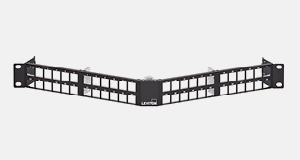
Patch panels are key pieces of passive network hardware that act as intermediaries between a building’s permanent Ethernet cabling and various kinds of active networking equipment. Patch panels are typically long metal sheets (either flat or angled) housing copper or fiber connectivity. Copper panels often include RJ45 ports on the front side and IDC blocks on the back. However, many patch panels are designed to house snap-in connectors or cassettes, like the Leviton e2XHD patch panel depicted below. Bulk cable is terminated at the back of the patch panel, with strands separating and being directed to each port. 

Patch panels are best understood as distribution hubs that simplify network management, expansion, and troubleshooting. While the device itself may appear underwhelmingly simple, the impact of incorporating such an interface, especially as networks expand and cabling starts to crowd, cannot be overstated. 


e2XHD High-Density Universal Angled Panel


e2XHD Panels, shown from behind in-cabinet with terminated cabling

Why Do I Need Patch Panels? 

Some may question why an intermediary is necessary. Why invest in a patch panel, when you can just plug in-wall cabling straight into equipment?

The simple answer is that patch panels provide a reliable, documented, testable, and traceable access point for cable management that allows for expansion and meets Category Ethernet standards.

In more detail:

  • Using a patch panel simplifies management with the ability to label ports and use shorter cables for connecting equipment.
  • Upgrading or replacing a switch is also easier – simply install it in the rack, configure it, and move the patch cables from the old switch to the new.
  • Shorter patch cords from panels are more flexible, resistant to damage, and provide protection to the switch or private branch exchange (PBX) by adding pull relief.
  • Patch panels also simplify troubleshooting, making it easy to isolate issues and perform maintenance with minimal downtime.

Let’s take a closer look at each of these four benefits, breaking down the additional utility provided by this deceptively simple interface.

Cable Management
Patch panels consolidate multiple cable runs into one access point, which has the effect of reducing cable clutter in your telecom room by cutting the amount of visible cabling. Patch panels are also typically located closer to active equipment, allowing you to use shorter patch cords instead of longer, tangled runs of cords.

This improves:

  • Space utilization - Less clutter allows for greater flexibility in infrastructure planning, opening up new room for expansions
  • Airflow - With “more room to breathe” thanks to the increased airflow in previously cramped spaces, increased heat dissipation unlocks greater efficiency for your active equipment
  • Standardization of infrastructure - Patch panels provide a simplified cable management framework that can easily plug and play across facilities, making it easier to standardize your cabling infrastructure

Of course, color-coding and labeling are absolutely critical for getting the most out of a patch panel’s cable management potential. 

Scalability
Patch panels are designed to allow new devices to connect to your network easily; just find an available port, plug in the jack or adapter, and you’re golden. Moves, add-ons, and changes are also significantly less painful, as any rewiring can be done without affecting the underlying infrastructure. This is because patch panels are designed to be modular; down the line, you can easily replace patch panels with solutions that offer greater densities per port or more ports, without rewiring walls.

In short, patch panels can be critical in alleviating network “growing pains,” facilitating rapid scaling with minimal downtime.

Physical Layer Protection
The very act of consolidating network access to a single point makes it much easier to add additional security measures and lock down your physical layer. Additionally, a well-organized patch panel setup (with color-coding and labeling) allows you to quickly identify if anything is out of place, or if unauthorized connections have been made. 

Network Maintenance
Similarly, a well-organized patch panel allows for quick troubleshooting of errant connections. Patch panels provide technicians with an easy interface with which to trace the cause of network errors, isolate the causes, and test fixes. Patch panels minimize the number of wires involved in making new connections – and because patch panels allow network technicians to isolate specific connections, any diagnostic work or experimentation with solutions will be restricted from affecting the entire network.

What Kind of Patch Panel Do I Need?

Now that we've established just how important patch panels can be, you'd be right to ask the question: which one's the right one for me? There's a vast array of patch panels out there designed for networks with different needs, ranging from smart buildings and the connected home all the way to AI and hyperscale data centers.

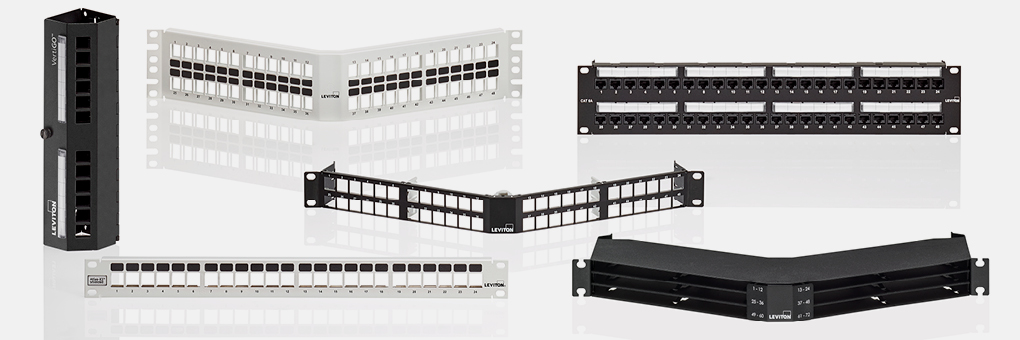
Leviton delivers industry-leading global patch panel solutions, backed by robust service, reliable logistics, and flexible options designed to meet the needs of any application. Our comprehensive offering includes:

  • e2XHD high density snap-in cassette panels simplify installation and improve cable routing, and allow for a mix of copper and fiber patching
  • QUICKPORT™ panels allow you to mix voice, data, video, and audio in a single panel using QUICKPORT connectors
  • 110-Style panels support high-speed data applications in Category 5e, 6, and 6A options
  • OPT-X™  fiber panels come in ultra high density (UHDX), high density (HDX) and standard density (SDX) for patching with cassettes, splice modules, or adapter plates.
  • Flat panels' traditional profile works well in almost any application
  • Angled panels optimize patch cord management and rack space utilization
  • The VERTIGO™ Zero-U panel provides improved cable routing and protection outside the traditional 19-inch rack


Learn more about Leviton's full array of patch panels »