A Guide to Selecting Enterprise PoE Solutions and Managing Temperature Rise
When Power over Ethernet (PoE) was introduced in 2003, it was available for only a handful of low-power operations and devices. Today, PoE is one of the fastest growing networking applications, and it is on the rise due to the wide range of benefits it provides, including:
- Lower cost compared to a line voltage system and a separate network for data
- Improved system control
- Greater operational efficiency
- Opportunities for technology expansion
- Network future-proofing
A wide range of enterprise devices and technology rely on PoE, including lighting, access controls, IP cameras, information kiosks, industrial automation equipment, and wireless access points (WAPs). With the advent of the Internet of Things (IoT) and digital buildings, PoE is poised for unprecedented expansion in the enterprise.
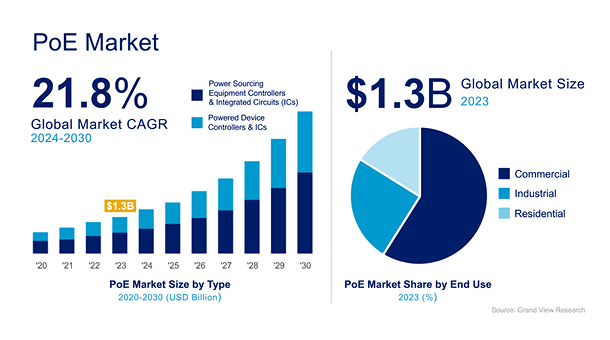
The PoE market has flourished and is projected to continue its rise through 2030, indicating a continuing demand for PoE capabilities in the enterprise.
What copper cable provides the best value for PoE applications, now and in the future? It won't surprise you that there isn't a "one-size-fits-all" answer; network architecture resists templatization, and so different copper cables will provide a better value in specific situations. However, a good rule of thumb is to choose a copper cable that can perform at the level of power needed without exceeding its maximum temperature.
What we aim to do with this article is equip you with the knowledge to choose the copper cable that will provide the best value for your network architecture, examining the varying characteristics of PoE copper cabling and the impact they have on temperature rise to help you identify the solution you need.