Benefits, Considerations, and the High-Flex Difference
As data center managers work to maintain and increase network performance, they are also faced with the need to reduce space requirements and energy costs. Similarly, enterprise IT directors need to balance their increased bandwidth requirements with day-to-day needs like reducing clutter, accommodating tighter spaces, and maintaining network consistency across multiple locations. With the increasing use of WAPs, IP connected cameras, and other IoT devices in smaller and smaller spaces, the ability of the patch cord to deliver a short-installed bend radius over the life of the installation has become more critical.
For a deeper look at what a patch cord is, and how to select the right patch cord for your network, read our previous blog “What is a Patch Cord”.
Flexible 28 AWG patch cords can address these needs. However, they do come with some design considerations, and these need to be understood by consultants, design professionals, and building owners in order to maintain the best network performance.
A Brief Guide to Small-Diameter Patch Cords
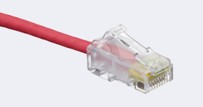
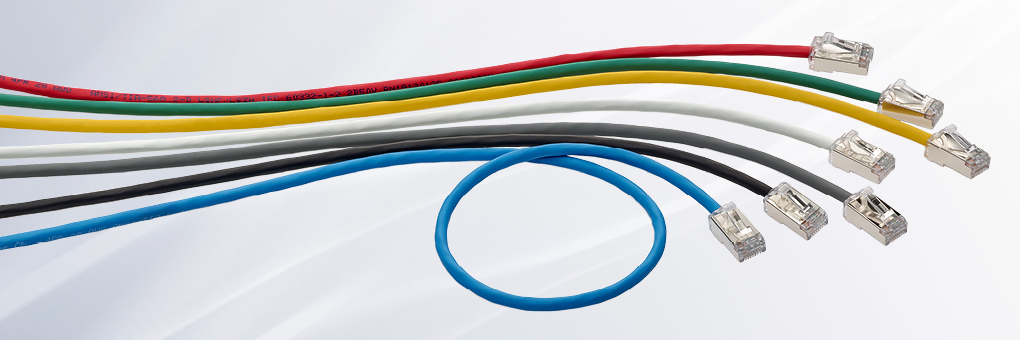
Small-diameter 28 AWG patch cords have been on the market for years, commonly used for data center interconnects in both end-of-row (EoR) and top-of-rack (ToR) installations. They have also been used to alleviate congestion and improve airflow in high-density areas such as telecom rooms and equipment rooms in hospitals, hotels, government, data centers, and other large facilities. And since these cords support PoE, they can also be used to power WAPs, IP cameras, VoIP devices, and AV equipment, in addition to carrying data to these end devices.
28 AWG patch cords are recognized as a category-rated solution through ANSI/TIA-568.2-D. Previously, TIA required category-rated patch cords have a 22- to 26-gauge construction, as smaller 28 AWG cords exhibit higher insertion loss, requiring the overall length of a channel be reduced to less than the industry standard 100 meters for category-rated cabling. However, due to the growing appeal of 28 AWG cords, they were recognized as a category-rated solution in June 2018. The addition of 28 AWG by TIA only applies to patch cords; horizontal cable still must be 22 to 24 AWG.
Considerations With 28 AWG Cords
Under the TIA standards, using 28 AWG patch cords reduces the overall channel length from 100 meters to 96 meters, with a maximum of 6 meters of patch cords and a 90-meter permanent link. If greater lengths are required for the patch cords (up to 10 meters max), you must reduce the length of the permanent link to shorter than 90 meters.
Also, when using 28 AWG cords for remote powering, there are additional bundling requirements to ensure adequate heat dissipation as outlined in the latest TIA Standard ANSI/TIA-568.2-E (October 2024). The updated standard provides limits on cables per bundle based on current per pair and ambient temperature, and limits bundles to 12 cables when delivering 30 watts and higher, with bundles spaced 1.5 inches apart. There are no bundle size limitations when 28 AWG cords are not being used to distribute power.