

Leviton Poll
Volume 17 | Issue 3 | 2026

Leviton Network Solutions Expands Capacity for Global Data Center Customers
As a privately-owned, single-source manufacturer of end-to-end structured cabling solutions, Leviton Network Solutions invests in our customers’ success. Our expansion efforts are geared toward providing speed and scale for our global customers, unlocking greater production capacity, enhanced configuration options, and more resilient supply chain redundancy.
Take our recent investments in our carbon neutral UK-based facility, which have unlocked over 100 configuration options for our high fiber count cable assemblies. The expanded portfolio increases capacity, shortens lead times, and provides greater manufacturing redundancy across regions. This is actively helping hyperscale, cloud, and enterprise data center operators keep pace with rapidly evolving AI and high bandwidth demands. These investments include:
- Launched fiber cassette production in the UK
- Completed a 180% expansion of our UK Data Center Factory
With manufacturing in both the UK and USA, including dual rated Riser/LSZH CPR B2ca constructions, Leviton offers customers more options for sourcing, simplifies project planning, and ensures key components are available when needed.
As a direct result of our investment in our manufacturing facilities, customers can expect:
- Loose tube fiber constructions up to 576 fibers
- Support for Base-8 and Base-16 configurations
- More dependable supply across regions via enhanced global redundancy
- Shorter, more reliable lead times across all data center builds
- High density connectivity optimized for AI clusters, cloud pods, and colocation sites
Leviton Network Solutions is committed to providing the industry’s best return on infrastructure investment, and that shapes our approach to expansion projects. Our dedication to growth is all about providing our clients with faster deliveries and deployments, deeper scalability, and agile, robust solutions with top-tier performance.
For more on Leviton’s commitment to growth, and a breakdown of the principles that guide our business, visit our About Us page.
Subscribe Today
Like what you’re reading? Get more industry news and trends in our quarterly newsletter when it’s hot off the press.
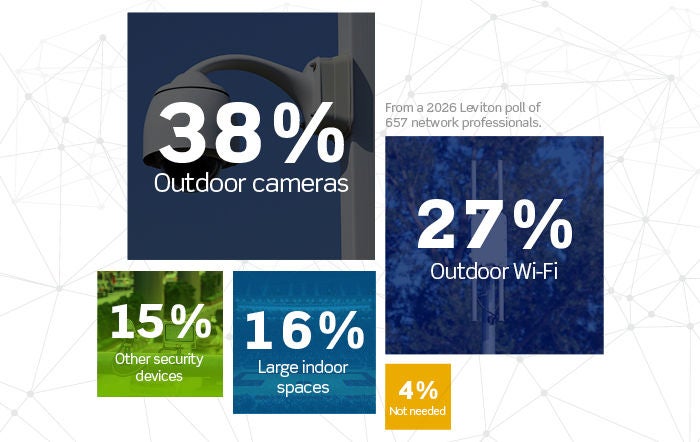
For which applications do you require extended distance capability beyond 150 meters?
(multiple answers were allowed)
Setting Standards: Where are we on Extended Distances?

It’s no secret that, for many, the 100 meter limit for structured cabling just isn’t cutting it anymore. For decades, the 100-meter limit for structured cabling shaped building and network design, because networks were centralized, devices were predictable, and most endpoints lived indoors. It has worked so well that, even as IoT devices proliferate, 100 meters is still widely accepted as the gold standard for performance and quality. Extended distance copper solutions are treated as working outliers, instead of having their own standards.
Leaders actively using extended distance solutions and those that anticipate a need for extended distance capabilities want to know: will parameters for extended distance solutions eventually be codified into standards? And if so, how?
To answer this question, we sat down with Todd Harpel, Leviton’s Sr. Director of Product Management and resident expert on extended distances. Todd is the current Chair of the CCCA Communications Committee, and also sits on the Telecommunications Industry Association (TIA) TR 42.7 committee, where he is currently the editor for a Telecommunications Systems Bulletin (TSB) for extended distance cabling. In the following interview, Todd gives us a peek behind the curtain, unveiling the discussion around extended distance in standards committees and possible plans for the future.
Q: The TIA TR42.7 committee is currently writing a TSB for extended distance over copper cabling; what would you say is the intent behind this document?
A: First, keep in mind that a TSB is not a standard. It is technical guidance. So when a user uses the document, they’re getting information on the use of certain types of cabling for things it was not necessarily intended or standardized to do. It’s a document that is intended to close the gap between what customers need and what the standards can currently provide, and as such it’s somewhat limited in its scope.
Q: Can you dive a little deeper into how the TSB is focused?
A: Sure! We’ve chosen to focus our efforts on defining distances that can be reasonably achieved by changing only the structured cabling system. From the members of the TIA who are providing comments, generally we have support for a length of about 150 to 200 meters depending on the Ethernet speed, if changes are made to the cabling system without touching electronics. We’ve settled on that as the foundation for the recommendations we’re making, while also putting a lot of risk analysis into the TSB; analyzing circumstances where, because the electronics are designed to support 100 meters, performance and quality might dip. We want the user to fully understand the risks of extending their systems beyond what they’re designed to support, giving them a comprehensive list of things they may want to try, components they may want to replace, and conditions under which performance may start to be compromised.
Q: Why focus solely on changing structured cabling? Why not include design recommendations for various switches?
A: The cabling is the component we have the most direct control over, and it’s where we (TIA) feel comfortable making qualified claims. That may change if switch manufacturers decide down the line to develop equipment designed to support 150 meters and above, but that’s not where we are yet. That would mean that their equipment would most likely be more expensive in order to support those lengths. And any new Ethernet transmission standards would be developed by IEEE 802.3 committees.
Q: The TSB is best understood as an interim measure, a way to provide guidance without a codified standard; do you think standards for extended distance will actually be set?
A: Hard to say. It’s a new concept, and one of several that the industry is choosing between, which is why we’re focusing on meeting needs in an advisory capacity now. The other technology enabling extended distance, I would say, is Fault Managed Power. A network design using Fault Managed Power may decrease the need for extended distance copper cable because you’re taking switches and moving them out onto the floor. And then you’re cabling out from those switches that are in ceiling containers or raised floors or whatever. And you are now already closer to the end device with those switches and using Fault Managed Power to power them. So you don’t need to have these extended reach connections when you’re using that kind of technology. Now that is still not a mainstream network design technique yet, but it’s certainly being well promoted, and it could eventually become common practice. I’d say the larger conversation around setting a standard will happen after the industry fully decides which of the two it prefers.
Q: So why bet on extended distance technology instead of Fault Managed Power?
A: Well, Fault Managed Power is still very much a nascent technology — it involves implementing a power technology to work alongside communication infrastructure create a new network architecture.. It’s interesting, but it’s also a system that is very different from what most end users and IT departments would be used to. There’s also a interoperability issue: Fault Managed Power requires you to use components from a single manufacturer, whereas extended distance systems are more flexible. Most network solutions manufacturers are sort of hedging their bets, dipping into Fault Managed Power and extended distance solutions; currently, our focus is on extended distance. Not a lot of customers are implementing fault-managed power systems at the moment, and we’d rather focus on meeting customer needs where they are than investing in a technology in its infancy.
For more on Leviton’s extended distance solutions, including our all-new PARADIGM™ structured cabling system, visit leviton.com/extendeddistance.
Spotlight: STRATA™ Fiber Ecosystem
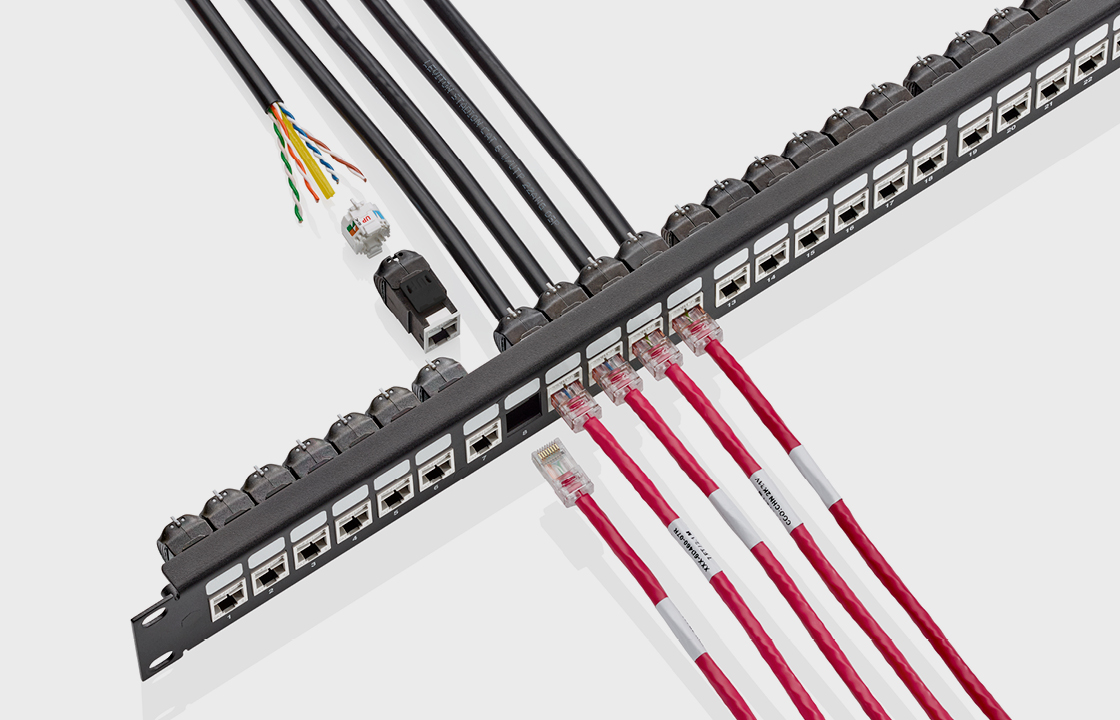
In November 2025, we announced our STRATA fiber ecosystem, designed to support the explosive growth of AI and hyperscale data centers. STRATA addresses the unique demands of these data centers for vastly greater densities, faster deployment, and scalable architectures.
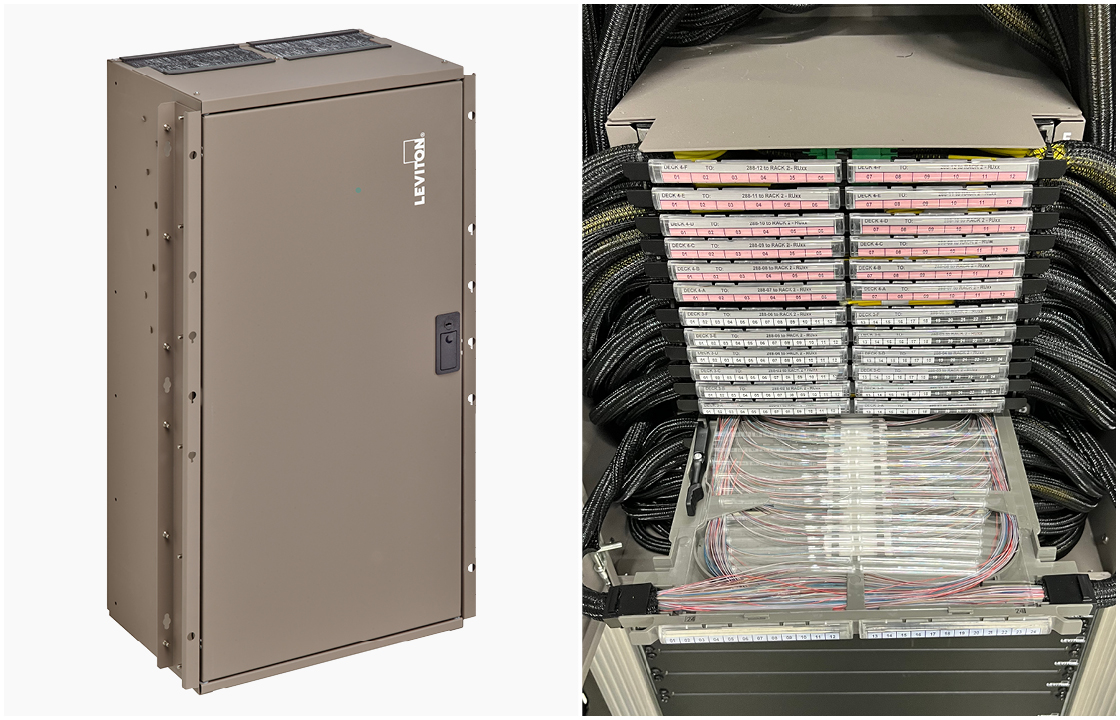
For example, the new STRATA IDX 20RU Fiber Enclosure addresses fiber density and cable management challenges for data center entry points. The enclosure supports up to 6,912 fibers for splicing or pre-terminated interconnect, helping operators manage the increasing volume of fiber entering and moving throughout the facility. The enclosure uses splicing and interconnect decks, creating a modular build-asyou- go solution.
You can learn more about our range of STRATA solutions at leviton.com/strata.
News You Can Use


Tech Tips: What’s the Difference Between Single-mode and Multimode Fiber?
When it comes to fiber optic cabling, one of the most common questions is whether to use single-mode or multimode fiber. Both move data as light, but they do it in different ways. The differences can have a big impact on performance, cost, and scalability, and understanding how each option behaves will help you make a smarter long-term decision.
Single-mode optical fiber supports one mode (path) of light travel using a laser light source. Because the light travels in a single, straight path, signal dispersion is minimized, meaning the signal stays cleaner over long distances.
Multimode optical fiber supports multiple light paths (modes) traveling through the core at the same time. It uses either an LED or a vertical cavity surface emitting laser (VCSEL) as its light source. Because multiple light modes are traveling simultaneously, signals can spread out and degrade over distance (a phenomenon called modal dispersion). This limits multimode fiber to shorter runs compared to single-mode.
Single-mode optical fiber is better for long-term scalability, higher speeds, and longer distances. However, it requires tighter installation practices for cleaning, loss, and reflectance. Single-Mode transceivers also typically cost more and use more power than multimode transceivers. Multimode cable is more cost effective for short distances, while less strict on cleanliness and optical performance.
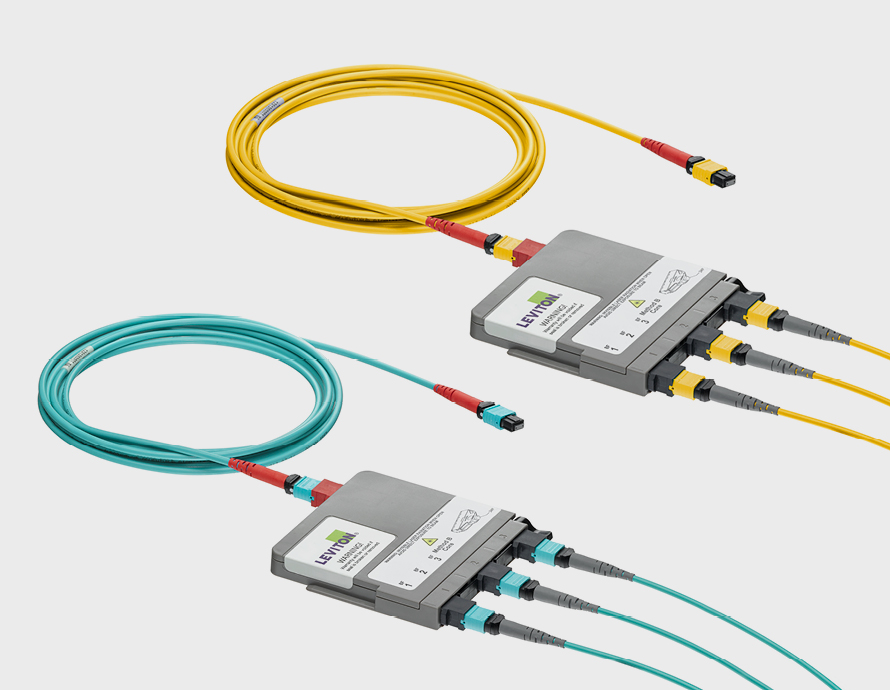
Regardless of the type of fiber network, IT managers are looking for cabling systems that can weather multiple generations of tech upgrades with minimal disruption, dark fibers, or changes. Leviton’s OPT-X™ single-mode and multimode cabling systems not only meet current bandwidth requirements, but also provide the flexibility needed to meet future network demands.
Ask the Experts
Q: What happens when indoor-rated cable gets wet?
A: Indoor-rated communications cable is constructed to operate in dry conditions. Where wet conditions exist (or may plausibly be expected to exist at a future date) industry codes and standards require the installation of outside plant (OSP) or indoor/outdoor-rated cables. When indoor-rated cable becomes wet, you should consider it permanently damaged and remove it from the site. Wet cable cannot be dried out. Water permeates the jacket material and permanently affects the data transmission characteristics of the cable.
Water damage to fiber optic cables results in high attenuation and degradation of the data signal. In copper cables, the initial indication of water damage is also high attenuation, but the cable quickly degrades further, resulting in eventual near-end crosstalk (NEXT) and Return Loss (RL) failures, rendering the cable completely useless for data communications.
Note: Consult with Leviton technical support team for best suited cable for your application.