

A Leviton Guide to Single-Mode vs. Multimode Fiber
When it comes to fiber optic cabling, one of the most common questions is whether to use single-mode or multimode fiber. Both move data as light, but they do it in different ways. The differences can have a big impact on performance, cost, and scalability, and understanding how each option behaves will help you make the best decision for your network long-term.
Single-Mode Fiber
Single-mode optical fiber supports one mode (path) of light travel using a laser light source. Because the light travels in a single, straight path, signal dispersion is minimized, meaning the signal stays cleaner over long distances.
Historically, single-mode fiber was primarily used in applications such as long-haul networks, service provider infrastructure, metropolitan area networks, and large campus backbones. These environments required transmitting data over miles, which is where single-mode excels. Today, single-mode fiber is also increasingly being deployed in shorter-reach environments, including data centers and enterprise networks. This shift is largely driven by the need for future-proofing, as single-mode can support much higher speeds and longer distances as technologies evolve.
Multimode Fiber
Multimode optical fiber supports multiple light paths (modes) traveling through the core at the same time. It uses either an LED or a vertical cavity surface emitting laser (VCSEL) as its light source. Because multiple light modes are traveling simultaneously, signals can spread out and degrade over distance (a phenomenon called modal dispersion). This limits multimode fiber to shorter runs compared to single-mode.
Despite that limitation, multimode remains the most common choice for LAN environments, including campus networks, office buildings, data centers, and horizontal and backbone cabling within facilities.
Its flexibility and lower system cost (especially for optical transceivers) have made it a go-to solution for in-building connectivity.
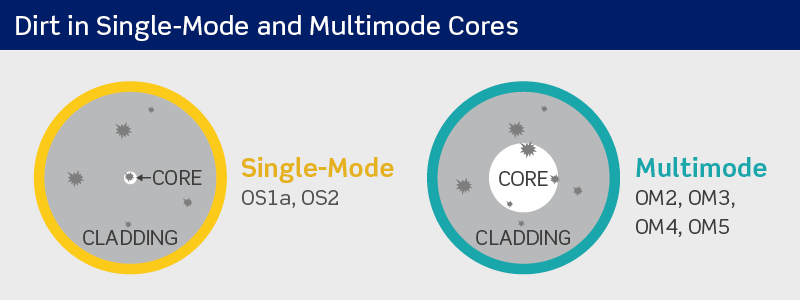
The core/cladding size of single-mode optical fiber is approximately 8.3/125 µm, where multimode optical fiber will have a 50/125 µm. Due to the much smaller core with single-mode, even a single dust particle can block the signal. This makes proper and thorough cleaning even more critical with single-mode fiber installations.